


.svg)
In our new series, The Bud breakdown, we break down complex ideas, processes, and platform features into easy-to-understand concepts, offering insight into how modern financial data works and how it can be used more effectively.
In this first article, we focus on transaction enrichment: A foundational capability for digital banking, money management, and customer engagement, and a key enabler of the future of banking.
The average adult American makes over 500 financial transactions per year, while our data tells us that an active banking customer can exceed 1,500. Many banks even define a “primary banking customer” as someone making 80 or more transactions per month – and these numbers will only continue to rise as cash declines, micropayments grow, and subscription models become the norm.
This volume of transaction data holds enormous value. It reflects not only past and present financial behaviour, but also future intent and life events; insights that are increasingly accessible through AI. Yet across the industry, transaction data remains significantly underutilised.
Despite appearing simple, transaction data lacks standardization. Each transaction may include an amount, date, and description, but also currencies, internal codes, processor data, and multiple states such as authorisations or reversals.
With multiple systems and intermediaries adding or removing information along the way, consolidating a complete and consistent transaction view (even for a single customer) is a challenge. That’s where transaction enrichment comes in.
Transaction enrichment is the process of transforming raw, inconsistent transaction data into information that humans and machines can easily understand and analyse. At its core, enrichment makes transaction data usable.
Categorization is often seen as the cornerstone of transaction enrichment – think seeing the category ‘Eating Out’ next to your Chipotle transaction in your banking app. Assigning meaningful categories to individual transactions enables budgeting, spending analysis, affordability monitoring, and more advanced AI-driven analytics by making patterns easier to detect. As such, granular, consistent categorization significantly increases the analytical value of transaction data for both customers and banks.
But good transaction enrichment goes further than categorization. A key component is identifying the businesses involved in transactions (commonly referred to as merchants, and sometimes including payment processors). Merchant enrichment can add brand names, logos, websites, and addresses, and enables geolocation of transactions where possible.
Another often overlooked but critical element is cleaning up transaction descriptions, improving user experience and reducing disputes caused by unrecognised entries. Presenting “AMZ*MKTP 123254” as “Amazon Marketplace – Online Retail” saves time for customers and reduces contact centre costs for banks.
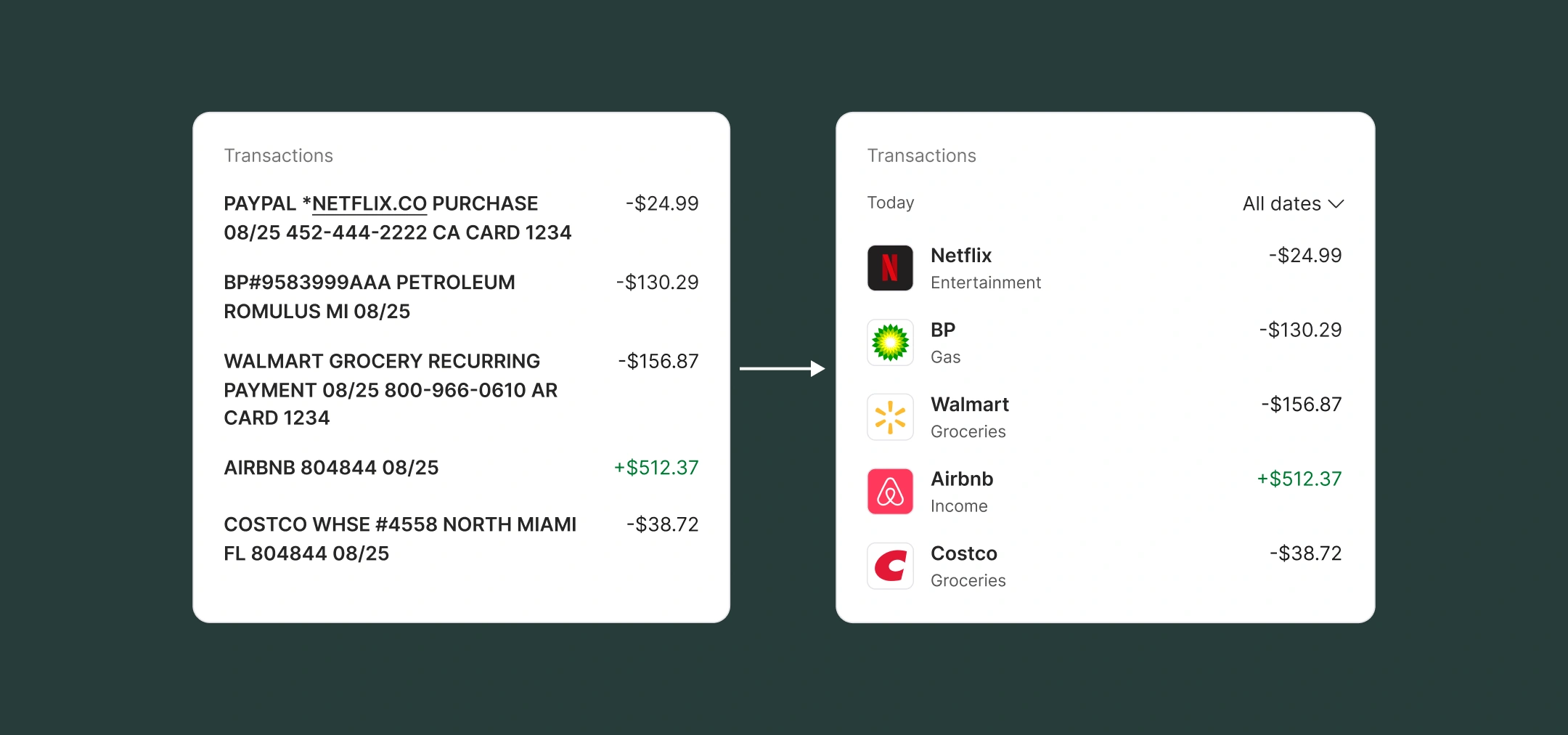
When transactions are analysed in the context of a customer, broader patterns can often be identified, such as recurring payments, subscriptions, or income streams. While these insights may seem obvious to customers, they are highly valuable to banks when combined at scale, forming the foundation of advanced transactional data analysis.
Historically, enrichment has been used primarily to improve customer experience and enable personal finance management tools. However, its value extends far beyond digital channels.
Enriched transactions improve fraud detection by providing cleaner, more structured inputs for machine learning models. They also enhance affordability and risk assessments, enabling better detection of income patterns and risky behaviours that traditional credit data may miss.
Another one of the largest untapped opportunities for enriched transactions lies in personalization and customer communication. Banks have invested heavily in CRMs, decision engines, and propensity models, yet often rely on limited financial signals such as balances or transaction totals. Enriched transaction data unlocks a much deeper understanding of customers, from lifestyle and interests to life-stage signals and early warning signs. Changes in spending patterns can indicate churn risk, affordability shifts, or upcoming major life events, enabling you to proactively reach out to your customer when it matters most.
Building effective enrichment is complex. Transaction data often originates from multiple systems and must first be consolidated.
Traditional approaches rely heavily on Merchant Category Codes (MCCs), which are limited to card transactions, inconsistently applied, and based on outdated taxonomies.
In practice, the most valuable signal comes from transaction descriptions, combined with amounts, currencies, and supplementary codes. These inputs power hierarchical categorization and merchant identification, though coverage naturally forms a funnel: most transactions can be categorized, fewer have identifiable merchants, and fewer still can be accurately geolocated.
At Bud, we take a different approach. Our platform combines multiple purpose-built AI models — including neural networks, custom embeddings, and supervised datasets — all operating under human oversight to minimise false positives.
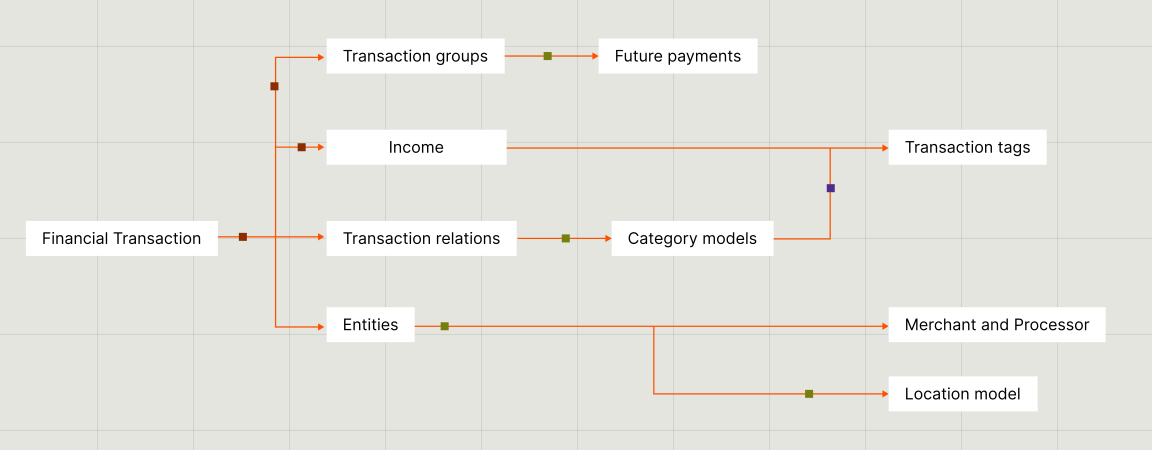
This architecture delivers high accuracy, speed, and explainability, while avoiding hallucinations and enabling continuous improvement. Models can operate independently or collaboratively, meaning that, for example, geolocation is not dependent on merchant identification. By curating models and data sources in-house, Bud can optimize for enterprise requirements, transparency, and performance.
Transaction enrichment at Bud is integrated into a broader platform where enriched data becomes the foundation for population-level analytics and customer-level insights.
Some clients deploy enrichment directly within core transaction flows via APIs, while others use it as the first step toward advanced capabilities such as affordability monitoring, digital channel improvements, and hyper-personalized communication.
So, transaction enrichment is not just a digital feature or technical add-on. It is a critical link between banks and their customers, enabling better understanding, more relevant engagement, and stronger financial outcomes. With enrichment as the foundation, banks can move from raw data to meaningful insight, and position themselves as trusted financial partners.
Keep your eyes peeled for the next Bud Breakdown article where we’ll explore personal financial management, one of the key areas unlocked by enriched financial data.
________________________________________________________________________
Transaction enrichment is the process of turning raw bank transaction data into clear, structured, and meaningful information. It typically includes categorization, merchant identification, cleaned descriptions, and added context that makes transactions easier to understand and analyze.
Transaction enrichment unlocks the value of transaction data. It improves digital customer experience, strengthens analytics and AI models, supports fraud and risk use cases, and enables more personalized customer engagement across digital and operational channels.
Enriched transactions help customers recognize where they’ve spent money, understand their spending patterns, and manage their finances more easily. Clear merchant names, categories, and descriptions reduce confusion and improve trust in digital banking experiences.
No. Categorization is one part of transaction enrichment, but enrichment goes further. It can also include merchant identification, description cleanup, logos, geolocation, recurring payment detection, and behavioral signals.
AI models analyze transaction descriptions and related data to identify merchants, assign categories, and detect patterns at scale. When combined with human oversight, AI-driven enrichment delivers higher accuracy, better coverage, and continuous improvement compared to rules-based approaches.
Yes. Enriched transaction data supports fraud detection, affordability and risk assessments, analytics, and personalized communications. It enables banks to better understand customer behavior and act on meaningful signals across the organization.
Transaction enrichment transforms raw, inconsistent banking transactions into structured, meaningful data. By adding categorization, merchant identification, cleaned descriptions, and behavioral insights, enrichment unlocks better digital experiences, stronger fraud and risk analysis, and far more personalized customer engagement. For modern banks, transaction enrichment is not just a UX improvement, it’s foundational infrastructure for turning financial data into actionable insight.

Product
Learn more about Bud's market-leading enrichment engine


%201.webp)

